 Daniel Morgan
Natural gas, inventories, weather and supply
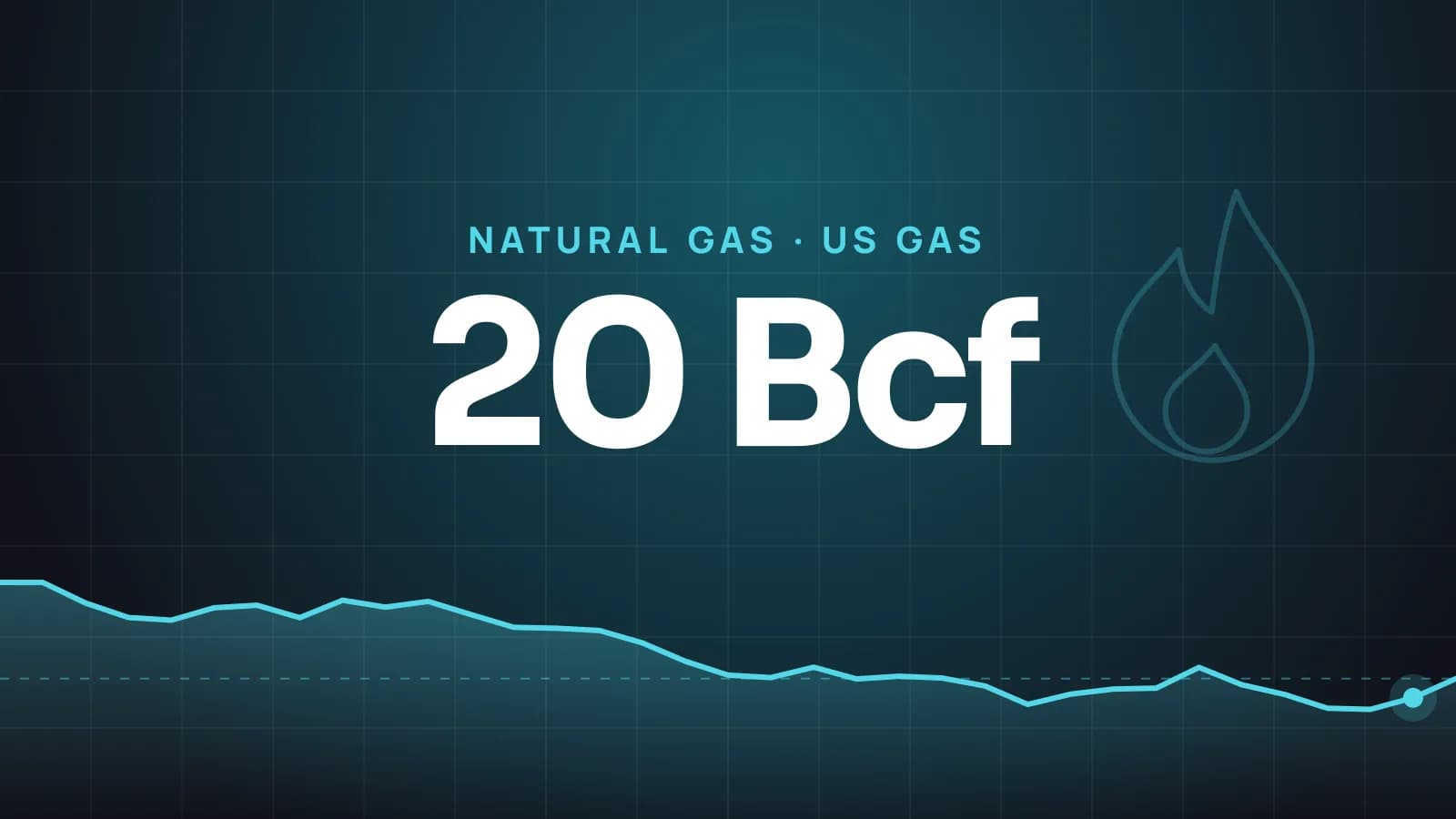
US working natural gas inventories rose by 20 billion cubic feet in the week ended November 13, according to the EIA's November 19 release. Stocks were above the five-year average but below the comparable year-earlier level, giving traders two different measures of the winter supply cushion. [1]
One stock level, two comparisons
Lower 48 storage reached 3,882 Bcf, up from 3,862 Bcf. That left inventories 80 Bcf above the five-year average of 3,802 Bcf, a surplus of 2.1%, while the year-on-year shortfall was 66 Bcf. [1]
The regional figures were mixed: South Central stocks increased 13 Bcf, Pacific stocks added 5 Bcf and Mountain stocks rose 3 Bcf. The East was unchanged and the Midwest declined by 1 Bcf. The EIA notes that independently rounded components may not sum exactly. [1]
The agency lists November 25 as the next release date. [1]
Analysis: choose the benchmark before the conclusion
Calling inventories ample because they exceed an average and calling them tight because they trail last year can both describe the same table. Neither statement alone establishes whether supply will comfortably meet the coming season's requirements.
The five-year comparison smooths several historical seasons into a reference point. The year-earlier comparison instead measures the change from one particular starting position. Each answers a different question, and both need to be weighed against prospective demand and available supply.
The latest injection also describes a completed reporting week. It does not establish that injections will continue or that colder conditions have been ruled out. Weather expectations can change after the survey period, leaving the storage observation accurate but incomplete as a description of the current balance.
Regional flows add useful detail
A national increase can coexist with withdrawals in individual regions because temperatures, consumption and pipeline movements differ. The regional split therefore helps identify where stocks changed, even though it does not by itself explain every cause.
Storage volume also differs from delivery capability. Gas held in one area may not be able to reach another quickly during a demand spike. Pipeline capacity, operating conditions and withdrawal rates can matter alongside the total quantity in storage.
For market interpretation, the surprise relative to prior expectations is another separate issue. This article does not label the injection bullish or bearish against a consensus estimate that has not been independently established.
What traders should watch next
Watch the November 25 report for the next comparable observation, alongside updated weather forecasts, production and export demand. A forecast is a prospective input; the subsequent storage change records the balance that actually occurred.
Track whether the five-year surplus widens or narrows over several releases and whether regional differences persist. That approach provides more context than attaching a directional price call to a single weekly injection.
Sources and verification
Verified November 20, 2026, by 6:06 a.m. Asia/Manila. Observations retain their stated dates. Analysis is editorial interpretation; forecasts are not confirmed outcomes.
#Xquote #NaturalGas #EIA #GasStorage #EnergyMarkets
Risk disclaimer: Trading and leveraged products can cause substantial losses. General information only; not personalized investment advice.