 Ethan Nakamura
Forex and central-bank developments
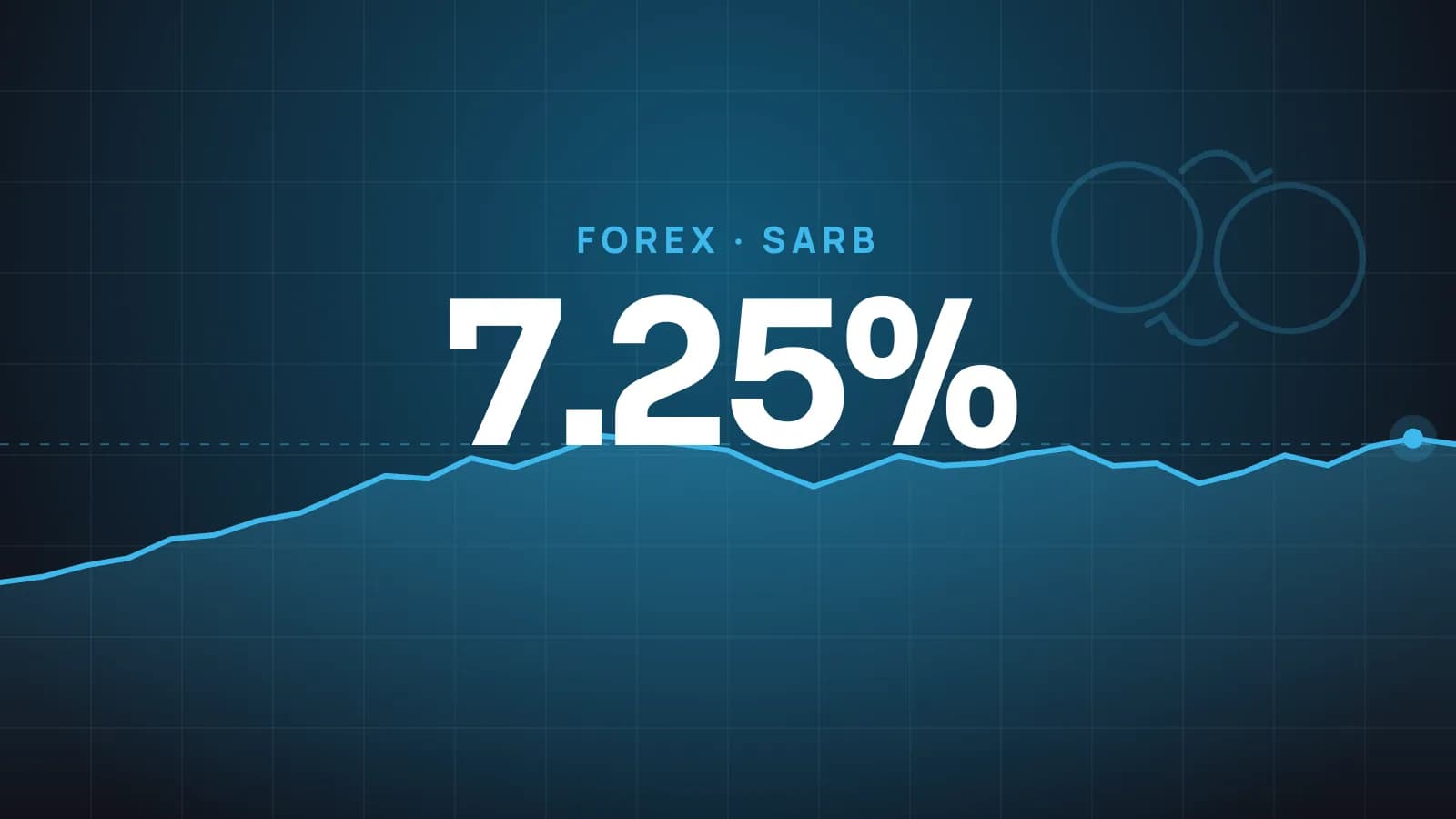
South Africa's central bank held its policy rate at 7.25% on November 19, with four committee members supporting the pause and three preferring a quarter-point increase. The narrow decision leaves currency traders assessing how much additional restraint could be needed to contain inflation. [1]
A pause with inflation concerns intact
The South African Reserve Bank assessed inflation risks as tilted upward and growth risks downward. It described near-term inflation above 5%, driven mainly by fuel, against its 3% target. Its next policy statement is scheduled for January 28. [1]
The bank's model still points to lower rates next year as inflation moderates, but policymakers explicitly treat that path as guidance rather than a commitment. Decisions remain dependent on incoming information and the balance of risks. [1]
Analysis: the vote changes the interpretation
An unchanged rate can represent very different policy messages. A unanimous pause after clear disinflation would carry different implications from a close decision with several members seeking more tightening. Here, the split indicates that the case for a further increase remains part of the discussion.
For the rand, that distinction matters through expected returns on local assets. Currency markets respond to the anticipated path of relative interest rates, not simply the rate announced at one meeting. A pause can therefore coexist with expectations of prolonged restraint.
The other side of the calculation is growth. Expensive credit can weigh on investment and household spending. If inflation pressure comes from imported energy, higher domestic interest rates cannot directly produce more fuel, although policy can influence demand, expectations and the currency channel.
Relative rates and purchasing power
A higher nominal interest rate is not automatically a stronger currency signal. Investors also consider expected inflation, exchange-rate volatility and the risk associated with holding local assets. A change in any of those factors can offset an apparent yield advantage.
Similarly, a model showing future easing is conditional on its assumptions. If inflation proves more persistent, the policy path can change without contradicting the original framework. Treating that model as a calendar of promised cuts would overstate what the bank has said.
What traders should watch next
Watch whether inflation expectations respond to the latest price pressures and whether underlying inflation begins moving convincingly toward target. Those developments would help distinguish a temporary fuel shock from a broader persistence problem.
The January 28 statement provides the next scheduled policy checkpoint. Before then, changes in global borrowing costs and the rand's import-price channel could alter the assessment. These are possible transmission mechanisms, not confirmed predictions of an exchange-rate move.
The practical reading is a conditional pause: the policy rate is unchanged, while the close vote leaves meaningful uncertainty about the next decision.
Sources and verification
Verified November 20, 2026, by 6:06 a.m. Asia/Manila. Observations retain their stated dates. Analysis is editorial interpretation; forecasts are not confirmed outcomes.
#Xquote #SARB #ZAR #Forex #InterestRates
Risk disclaimer: Trading and leveraged products can cause substantial losses. General information only; not personalized investment advice.